
Why puppy socialisation is about more than confidence
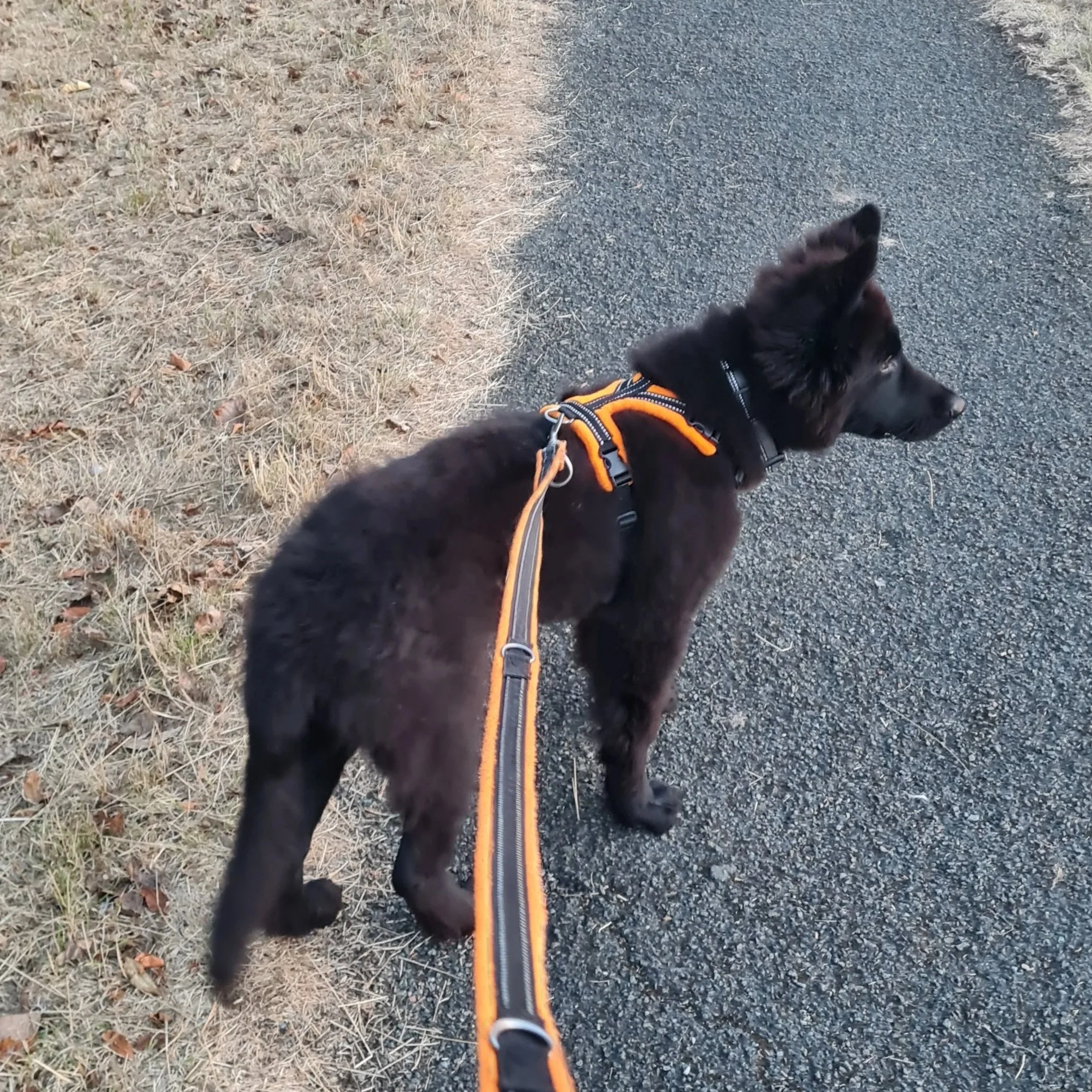
Ziva, looking across the field at traffic
Talking about puppy socialisation…again
We often think about puppy socialisation as giving our dogs confidence in different situations. I've mentioned before that it's really about exposure to all the senses and experiences, without necessarily getting involved. But we're human, and we naturally focus on what we think matters: confidence in all situations, being friendly with people and dogs, coping at the vets, settling in a café. (Not saying these things don't matter, of course they do.)
But there's a piece missing, and it's probably a bigger cause of problems than a lack of confidence, optimism, or friendliness ever is.
It's whether the puppy thinks what they're seeing is their business
Because if they decide it is, it doesn't matter whether they're confident, excited, worried or optimistic about it, they'll find it hard to disengage from it and re-engage with you.
And at adolescence, that often looks like: running over to every dog, chasing things, jumping up, predicting when one thing will lead to another (which ramps up arousal and feeds a whole vicious circle of frustration) etc.
This is why I work hard for Ziva to be neutral about most of the world. And no, I'm not perfect, I've been caught off guard when I didn't want her to greet someone or another dog, but I try to tip the odds in my favour.
Why traffic, and why it matters more for some dogs than others
One reason I'm talking about this is that confidence is not something Ziva struggles with, she has it in bucket loads. But it's in her genes to be aware of movement. So part of her socialisation is to be neutral about things that move.
This is worth dwelling on if you have a herding breed, a sighthound, or any dog bred to track, chase, or respond to motion. Selective breeding for generations built a heightened sensitivity to movement into these dogs. They have a low threshold for noticing it and a strong pull to orient toward it. Ignoring it, or assuming a confident, well-socialised puppy won't develop a reactivity problem, is where a lot of people get caught out.
At the moment, we're working on traffic, which Ziva is very aware of. Understandable. It’s noisy, fast and very visual. What I don't want is for her to decide this is something she needs to be involved in. Right now, she stands and stares, but that's enough to tell me it's a "thing" for her. The risk is that if I ignore it, she’ll become more and more aware of it, she’ll start to have big feelings about it and she’ll begin reacting to it instead. And just a note, this is not at all uncommon in herding breeds once the pattern sets in. I’ve seen it in many Shepherds and Collies.
How I work on it: Distraction, Mark, Treat
For short sessions, when it's quiet, some distance from the traffic, we work on disengagement using a technique called Distraction, Mark, Treat.
I see or hear the car (she's going to notice it anyway, I don't need to point it out).
I say "Nice," which is a marker word that tells her food is coming, and eating is an enjoyable experience.
Depending on how distracted she is, I might roll the food along the floor, or feed straight to her mouth (another tip, being still when a dog is very stimulated, being still is hard for them, so rolling the food a little helps them deal with the ‘ants in their pants’ and create a more enticing experience for them) .
Two really important things here:
I’m not distracting her with food. If she ignores me when I say ‘Nice’ she’s too close to the traffic (note: we’ve powered up the word ‘Nice’ with food in non-distracting environments, so she knows it’s a good thing)
She doesn't have to do anything to get the food. Not look at me, not sit, not even disengage from the car. The traffic just gets associated with a calm (or calmer), pleasant outcome.
This means that, over time, the traffic becomes less important to her, and, through her own choice, without any force or pressure from me, she'll engage with me more and likely start to ignore the traffic altogether.
How do you know if it’s working?
Today's mark of progress: she heard the car and turned to me before I'd even said "Nice." This is a sign Ziva is improving her skills in disengagement and re-engaging with me.
And I don't just practice with traffic, either, because that risks making traffic the focus. Pigeons, bunnies, people, trolleys, other dogs, things blowing in the wind, strange noises, low level distractions, they all get the same treatment, until it's just a habit. Ziva sees a distraction, she turns to me, I say ‘Nice’, she gets a piece of food. It does take a bit of forward thinking: having a portion of her daily food ready so I can catch the moment when it comes up, but that’s not too much of a challenge. Yes, it is harder if you have a small dog. That’s when you need to be more choosey about the experiences you expose them to, and be creative about the ‘treat’ part of the technique. It might be chopped up veg, or a lick of a frozen kong. It doesn’t always have to be food, but that does work best for calmness.
The bottom line
Puppies aren't blank slates. They'll have natural tendencies toward things we'd rather they didn't. Crossing your fingers and hoping they'll grow out of it is a risky strategy. If you're seeing a behaviour you don't want your pup rehearsing, or getting worse, get help from a professional early. Prevention is always easier than cure!