
Watching Mabel move: What a 4-second video can tell you
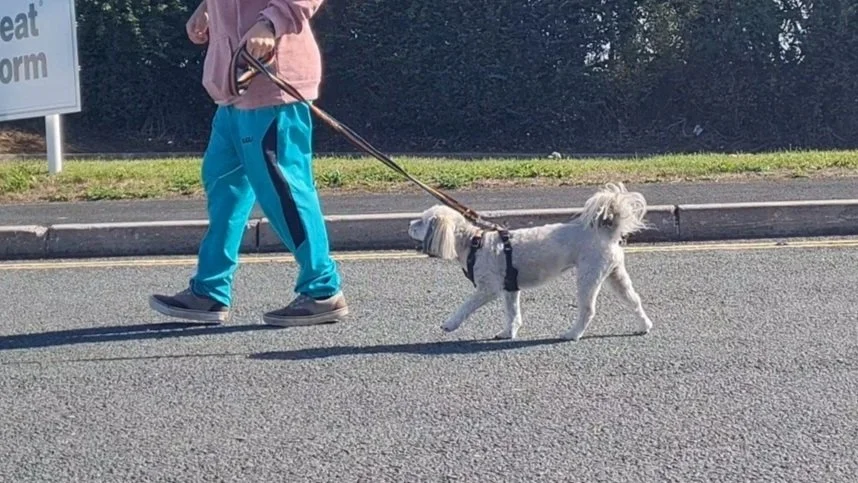
Mabel mid-trot. What do you notice about her posture in this image?
I'm a complete canine movement and posture geek. I can spend hours looking at it because it tells us so much. And I’m equally passionate about spreading the knowledge because I believe this is a skill anyone can start building.
Movement is one of the clearest windows we have into how a dog is really doing, often well before anything else changes. Of course, a limp is obvious. But the more subtle changes like a shortened stride, or a low head carriage tend to show up long before anyone notices there’s a problem. And sometimes what gets labelled as "just behaviour" turns out to have a physical thread running through it too.
So, the more people who learn to question what that movement might mean, the earlier those signs get noticed, and the better placed we all are to have effective conversations with a vet, a trainer, or a behaviourist. That's why I hope sharing observations like this one might help you build the habit of noticing and questioning, so you know when something's worth digging into further.
BUT!
Before we get onto the lovely Mabel herself (and many thanks to her person for allowing this video to be posted), a quick note on what this is and isn't.
We’re not looking for perfect movement here, because in the real world, few dogs (or humans) move with textbook perfection. I know I don’t!
What follows is an observation, not a diagnosis. Some of what we see may reflect Mabel’s structure; some may be an adaptation to physical or emotional discomfort; and some may simply reflect how she felt in that place, on that day. That’s why we look for patterns across different movements, settings and points in time.
And it’s worth remembering, this is just a tool. It’s not perfect. I won't spot everything, and that's okay. No one does. What one person notices, another might miss entirely, we're all still learning to see. So as you watch the footage, don't worry about catching every detail I mention, or feel you need to spot something I didn't. I'm also going to avoid technical jargon as much as I can. Learning to really look at a dog shouldn’t require you to be an expert in anatomy. If a term sneaks in, I'll explain it as I go.
As I watch any video of a dog moving, I'm holding six things in mind; what I call the Six Qualities of Canine Movement™ (here’s a link to the FREE guide if you’d like to read more Six Qualities of Canine Movement™ . As you read, you might find it helpful to ponder on them too:
Comfortable — any sign of guarding, hesitation, or reluctance to move fully
Coordinated — whether the limbs work together smoothly, or something looks slightly out of sync
Balanced — whether weight and effort are shared evenly, front-to-back and side-to-side
Adaptable — how easily the dog adjusts between postures, paces, and surfaces
Capable — whether the movement looks well within the dog's comfortable range, or shows signs of strain
In Control — whether the dog looks like they're choosing and directing their movement, rather than reacting to it
You don't need to spot all six, just keep them to the back of your mind while you watch.
Setting the scene
A few things worth knowing before we start, because context is important, and this is part of using the Six Qualities to help see the bigger picture :
Mabel is wearing a harness. Harnesses can restrict how freely the front legs move, but hers is loose, there's plenty of room around her shoulder and nothing tight under the armpit. Videos don’t have to be perfect, movement in real-life can still be very revealing.
She's in an unfamiliar location. New places can make a dog tense, which can show up as movement that looks restricted rather than loose and flowing.
The lead is loose, and whether a dog is on or off lead can change their movement too.
The surface is level tarmac with plenty of grip, so there’s nothing slippery to complicate her movement.
It's a warm, sunny day; not overly hot, but warm enough that some panting is expected.
We're watching her left side. A single camera angle only shows you one side clearly.
All of this context matters. When we question if movement is Adaptable and In Control, we need to ask whether the dog can adjust comfortably to the environment and if their movement is self-directed, rather than affected by tension or being restrained.
Right, let’s get to it!
Mabel trotting and walking, filmed from her left side and slowed right down so you can really watch each stride. Before you read on, see what you notice about her front leg reach, her topline, and how her hind end moves
Starting with her face and head
She's panting a little. I'm crouched behind a tripod nearby and that’s a spooky thing for any dog! But Mabel doesn't seem too concerned.
She has a little yawn towards the end.
The position of her head is relatively low. (Keep that in mind; there's a reason for it, which becomes clearer once we look at her back legs.)
Her coat is clipped, and there are possibly some slight ripples along her back.
The trot: front legs
Mabel starts off trotting. Watching her front legs, they don't reach very far forward with each stride. Instead, she tends to bounce upward. To make up for this shorter reach, she flicks her front paws, rather than reaching cleanly forward. It's not an efficient way of moving.Through the lens of the Six Qualities of Movement, this makes me curious about Coordination and whether this is a Capable movement strategy for Mabel. She is successfully getting from A to B, but the extra upward movement and paw flick suggest that the stride may require more effort than a smoother, more forward-reaching trot. Again, we need to think of this in context. Is she doing this to match the speed of the person she’s walking with?
In a good trot you might expect the toes of the front paw to land roughly in line with the tip of the nose, if you imagined a straight line dropped down from her nose to the ground. However, this is only a rough visual guide, as speed, structure and head position all affect where the paw lands, but it’s worth noting Mabel isn't quite reaching that.
A trot is a useful movement to look at because it’s a "two-beat" gait; the front left leg and back right leg move together, then the front right and back left move together. Because of this pairing, a trot often makes left-right differences easier to spot than a walk does.
Her elbows appear to be pointing straight backwards as she moves, rather than winging outwards or being held tightly to her body.
The walk: front legs
Watching her walk, there are a couple of moments where the right front leg's swing phase (when the paw is off the ground) is shorter than the left's, and occasionally, the right front reaches further forward than the left. Worth flagging that this last point is a judgement made by eye. For a formal assessment I would measure this because appearances can be deceptive!
In Mabel's case, there's no obvious head bobbing. This is often one of the more visible clues to look for, since a head bob usually means a dog is shifting weight off one leg and onto another, often to avoid loading a sore limb. For the front legs, there's a handy rule of thumb: the head tends to drop down when the sound (comfortable) leg hits the ground, and rise up when the sore leg takes weight (sometimes called "down on the sound"). It's a useful starting point, though the same rule doesn't translate quite as neatly to the hind legs, where the signs tend to be more subtle and harder to read this way.
Those small left–right differences bring two of the Six Qualities into focus: Balanced, because we’re considering whether weight and effort are shared evenly, and Coordinated, because we’re looking at whether the limbs move together with a consistent rhythm. Although a difference doesn’t tell us the cause, it gives us something specific to keep observing.
Her back (topline)
The "topline" is the line along a dog's back, from the base of the tail to the shoulders. In Mabel's case, it isn't level; it slopes downward from a higher point at the rear to a lower point at the shoulders. This type of posture may contribute to greater loading through the front of the body and lead to a lower head position.
There's also a slight convex curve over the loin, sometimes described as a "roach." This is natural in some breeds, but it can also come from weight shifting, the position of the hind limbs under the body, or even gut discomfort.
This is a good example of why the Six Qualities aren’t separate boxes. A change in Balance, such as more weight being carried towards the front, may influence Coordination, head position and how comfortably the limbs can move through their available range.
Her tail
Nothing unusual here! It's carried upright with a curl over her back, and sways evenly from side to side with no obvious lean to one direction.
Her hind legs and rear structure
This is where the "bum high" appearance (rear higher than the front) ties together with everything above. When Mabel trots, her hind legs generally stay under her body rather than stretching out behind her, and, remembering we're only watching her left side, as noted earlier, she may be landing on the outside edge of her paw, with the leg angling in toward the midline of her body.
It’s worth noting that dogs typically carry around 60% of their body weight on their front legs. Because Mabel is higher at the rear, her front legs are likely carrying even more than that.
Her left hock (the joint partway down the back leg, roughly equivalent to an ankle) has a slight sideways movement outwards when she lands. She's also quite straight through the rear overall, meaning the angles through her thigh, knee, and hock are wider than average, making her stand more upright through the back end.
Sometimes this kind of straighter structure is simply how a dog is built. Other times, it can be an adaptation. Standing more upright, with the leg working more like a straight column of bone, can be less tiring than relying on muscles to support a more angled leg.
One more note from the walk: her left hind leg has a longer swing phase (the part of the stride where the paw is off the ground, moving forward) than the right.
Here, I’m holding several qualities in mind at once. Is Mabel’s weight distributed in a Balanced way? Do the hind limbs appear Coordinated from one side to the other? Does keeping the legs beneath the body help her move Comfortably, and how Capable is that strategy across different paces and situations?
What I haven't told you
I've described what I saw, and a little of the "why it might matter", but I purposely haven’t provided a conclusion. I know that’s frustrating! Structure, environment, mood, and discomfort can all produce similar-looking patterns, and untangling which is which takes more than one four-second clip. But it’s certainly enough to make us curious and explore more.
Looking at Mabel through the Six Qualities helps to organise what we notice. For example, this 4-second video might make us curious about Balance from front to back and side to side, Coordination between the limbs, and how Comfortable and Capable some of her movement strategies may be. Adaptable and In Control would need more footage to explore properly, perhaps watching her change pace, transition from a sit-to-stand, turn in a circle or negotiate different surfaces. Recognising what we can’t assess is also an important part of the framework. So, if watching this made you want to look more closely at your own dog, that's exactly the instinct I'd encourage you to follow!
If you're a dog professional and this kind of close observation is something you'd like to build as a proper skill, this is exactly what I teach in Movement Matters, my course on canine structure, movement, and the pain-behaviour connection.
If you’re reading this because something about your own dog’s movement has made you curious, my Movement and Posture Assessment provides a structured, video-based analysis, with a written summary to help you understand what you’re seeing and support a conversation with your vet where appropriate.