

Recovery-Phase Conditioning Support
in Plymouth
Structured, hands-off conditioning support for dogs recovering from injury, illness or surgery
Structured, hands-off conditioning support for dogs recovering from injury, illness or surgery.
I work within veterinary-defined activity restrictions to help you implement safe, controlled movement during the recovery phase.
Veterinary examination and consent are required before recovery-phase conditioning begins.
Who this service is for
This service may be suitable for:
Dogs recovering from orthopaedic surgery (e.g. CCL procedures)
Dogs with joint disease
Dogs under veterinary exercise restriction
Dogs returning to activity following illness
Owners seeking structured support to carry out veterinary advice safely
What recovery-phase conditioning focuses on
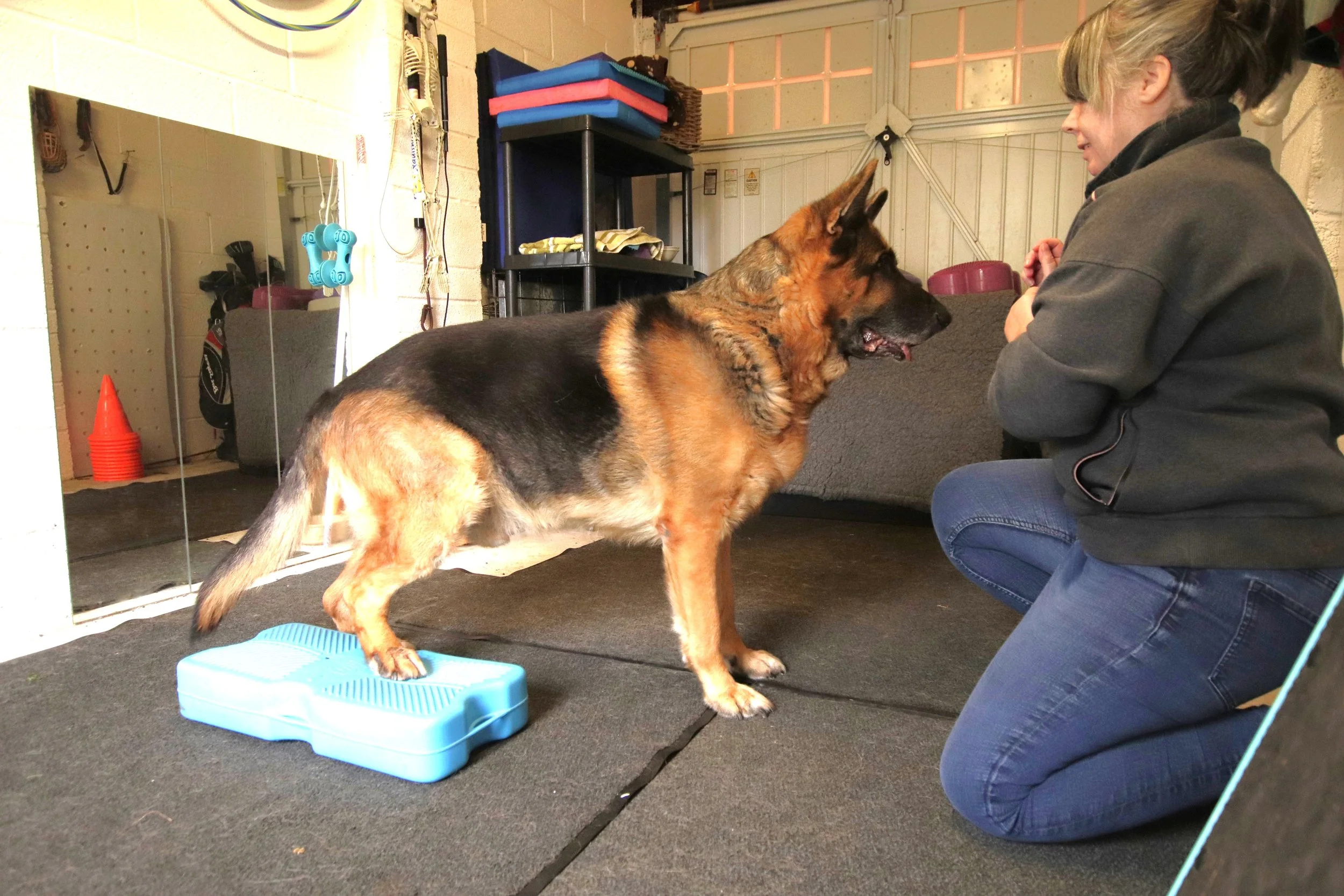
Sessions focus on safe movement quality and controlled strengthening within current veterinary restrictions.
Active muscle engagement
Symmetry during controlled exercise
Fatigue monitoring
Calm, low-arousal exercise routines
Environmental adaptations (flooring, access, stairs, confinement)
Owner coaching to ensure correct execution
“Tracey is incredible. She has been integral to getting the help my girl needed to be pain free and living a very happy life. I would not hesitate to take any of my dogs to see her.”

Step 1: Initial recovery consultation
This session includes:
Review of veterinary instructions and activity restrictions
Observation of posture and movement within current limits
Baseline symmetry and fatigue tolerance assessment
Environmental review (flooring, access, confinement, setup)
Behavioural considerations affecting recovery
Structured recovery-phase plan
Initial consultation – £165
This consultation ensures all work remains aligned with current veterinary recommendations before conditioning begins. Before recovery support can begin, your dog must have been examined by a veterinary surgeon for the relevant condition. I will seek confirmation from your vet that they are aware of and consent to structured conditioning support within their stated activity recommendations.
Step 2: Recovery conditioning sessions
Following the initial consultation, sessions focus on:
Controlled muscle activation within restrictions
Movement quality and symmetry
Fatigue monitoring
Calm progression of exercise difficulty
Environmental adjustments as recovery progresses
Owner coaching to ensure safe implementation
3 session programme – £210
5 Session programme – £325
8 session programme – £480
Exercise progression is based on observed movement quality and fatigue tolerance, while remaining within veterinary-defined activity limits.
Please email me at hello@shapingdogs.com if you’d like to book a programme.
A different kind of support
This service focuses on structured, targeted strengthening delivered through your dog’s own movement, not manual therapy. Think of this as structured, controlled strengthening, similar in principle to Pilates for humans, but tailored specifically to your dog’s body, condition and stage of life.
I also don’t need to physically manipulate your dog to assess how they are loading, compensating or engaging muscle groups. Careful observation of posture, transitional movement and weight distribution provides valuable insight.
My background in canine behaviour also means I consider emotional confidence and subtle avoidance patterns, not just mechanics.
Veterinary Collaboration
I do not diagnose, manipulate joints, or treat pathology. I support movement quality, conditioning precision, and owner implementation within restrictions already given by a veterinary surgeon .
Where signs of instability or deterioration are observed, veterinary review will be recommended.
Frequently asked questions
-
No. This service focuses on structured, movement-led strengthening and joint support rather than manual therapy or rehabilitation techniques.
I assess posture, weight distribution and functional movement to design a personalised exercise plan. This approach complements veterinary care and can sit alongside physiotherapy if your dog is receiving it.
-
Yes. Recovery-phase conditioning is provided for dogs who have already been examined by a veterinary surgeon. I will contact your vet to confirm consent before beginning structured support.
This service does not diagnose or treat medical conditions. If I have any concerns during assessment, I may recommend veterinary review.
-
Yes, provided your dog is stable and under veterinary care where appropriate.
Targeted, low-impact strengthening can help support joint stability, improve coordination and maintain confidence in dogs with joint changes. Exercises are carefully selected and progressed at an appropriate pace.
-
Older dogs often benefit significantly from structured mobility support.
Ageing naturally affects muscle mass, balance and coordination. Controlled strengthening can help maintain stability and protect vulnerable joints.
-
The session includes:
Observation of posture and weight distribution
Assessment of functional movements (such as sit-to-stand and turning)
Discussion of your dog’s lifestyle and environment
Demonstration of tailored strengthening exercises
You will leave with a personalised mobility and joint support plan.
-
No. This is a movement-led approach.
Careful observation of how your dog loads and moves provides valuable insight without the need for manual manipulation.
-
General exercise maintains fitness. Targeted strengthening supports specific muscle groups that protect and stabilise joints.
This work is controlled, low-impact and progressive — closer in principle to Pilates than high-intensity fitness.
-
Every dog is different.
Some owners notice improvements in confidence or movement quality within a few weeks. The focus, however, is long-term support rather than quick fixes.
Consistency is key.
-
That is absolutely fine. This approach does not rely on manual handling.
In fact, dogs who are touch-sensitive often respond well to structured movement work.
-
Yes. Joint and mobility support is not only for seniors.
Younger dogs with early joint changes, previous injury (with vet clearance), or subtle instability can benefit from proactive strengthening.
-
The initial session includes your personalised plan.
Some owners choose occasional follow-ups to progress exercises and refine technique. Others feel confident continuing independently.
Ongoing support is available but not required.
-
This service is designed for owners who are happy to implement a structured plan at home.
Strengthening and mobility support require consistency and gradual progression.
If you’re looking for a one-off solution without ongoing input, this may not be the right fit.